
Resurrecting a Submarine Pioneer:
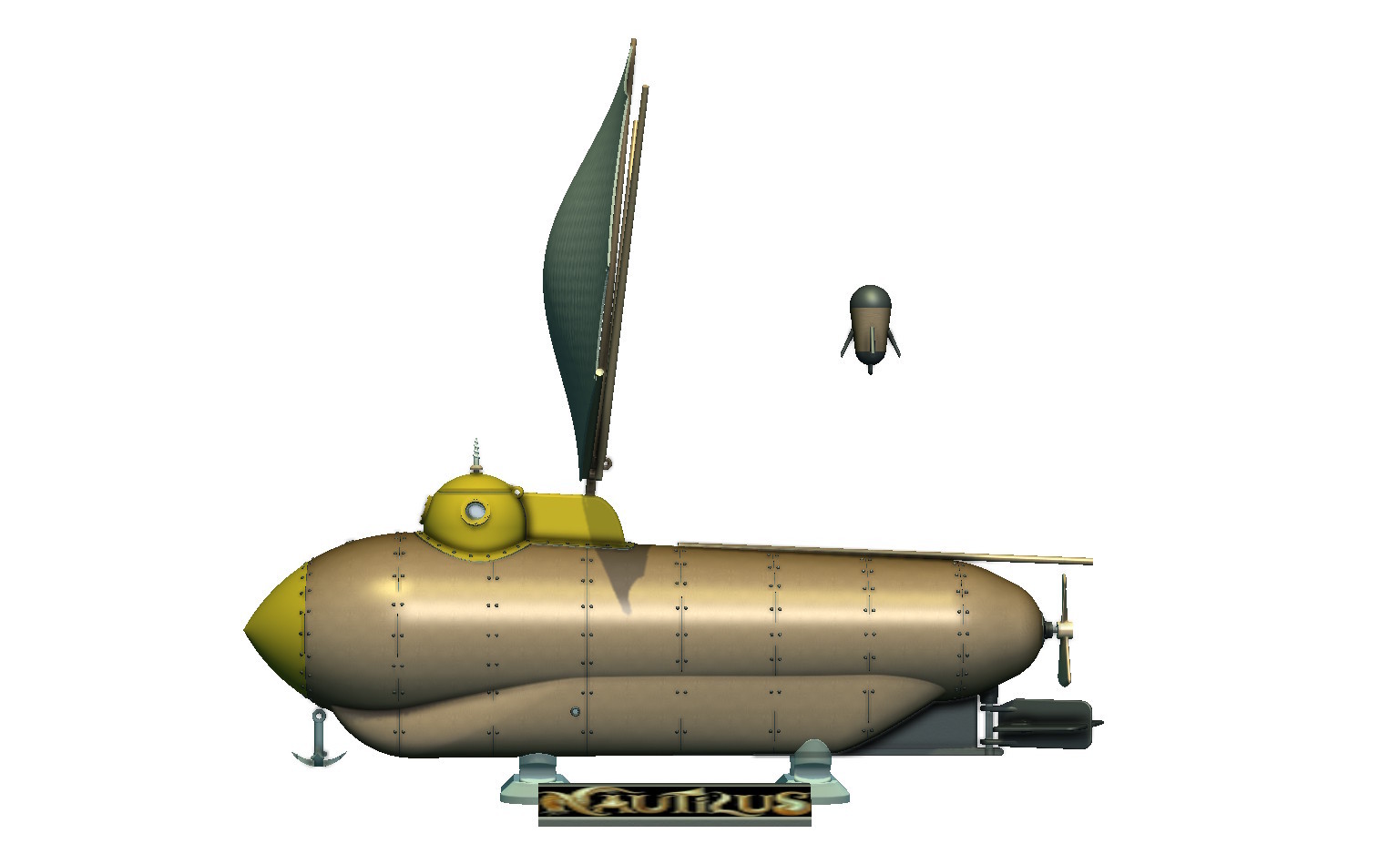
Bringing the Dawn of Subsurface Engineering, Articulated Mechanical Details, and an RC-Ready Core Straight to Your Desktop Workshop.
Before massive steel hulls and nuclear reactors ruled the deep, there was a copper-clad dream conceived in Paris and built on the banks of the Seine. Robert Fulton’s 1798 Nautilus stands as one of the most daring milestones in maritime engineering. Initially commissioned under the French Directory, this pioneering vessel proved that underwater navigation was not just science fiction but a functional, strategic reality. Today, the 1798 Nautilus-Inspired Submersible Kit is officially live on our studio store! You can now explore the entire file matrix, review the assembly layout, and secure your digital download directly via our Cults3D portal.
Continue reading for more info about the hand-cranked terror of the Seine
or proceed directly to our purchase page on cults3d to get your own Nautilus 3d model.
The Hand-Cranked Terror of the Seine
Designed by American inventor Robert Fulton in 1798 and launched at the Perrier boatyard in Rouen in 1800, the original Nautilus was an engineering marvel for its time. Measuring 21 feet 3 inches (6.48 meters) in length, the vessel featured an iron-ribbed hull sheathed entirely in copper sheets. On the surface, she sailed under a unique, collapsible Chinese-junk-style canvas layout. When preparing to submerge, the entire mast folded flat into a dedicated deck groove. Propulsion beneath the waves relied entirely on human grit: the crew manually turned a hand-cranked screw propeller to achieve a submerged speed of around two knots. Navigation was handled from a small forward metallic dome—a conning tower fitted with thick glass side-ports that also served as the watertight entry hatch for the brave crew.
Meticulous Engineering: Inside the EnDTaS Kit
Our interpretation honors Fulton’s historical design while completely optimizing the structure for the modern maker community and radio-control hobbyists. Scaled to a commanding 1:12 scale with an overall length of 650mm, this robust kit balances historical aesthetics with practical, clean printability.
The digital package is delivered via 35 high-poly STL files and a pre-separated, pre-colored 3MF file. The main hull is engineered into 6 heavy-duty sections boasting a secure 3mm wall thickness and a completely hollow interior. This leaves vast internal clearance for builders to adapt their own custom electronics layouts, servo brackets, or a dedicated water-tight cylinder (WTC). (Note: Dedicated RC gear, electronics, and internal mechanical linkages are not included in the baseline pack).
To eliminate guesswork and alignment errors during fabrication, all interlocking hull boundaries are designed with smart alignment flanges and lip-groove joints that securely lock sections together during gluing. For maximum usability, the middle two hull segments separate cleanly, transforming the upper deck into a massive main access hatch. Additional functional details include:
- An operational forward conning tower hatch that opens and closes.
- Fully articulated rudders and diving planes ready for immediate mechanical linkage connection.
- A fully moveable, rotating, and collapsible mast system that folds flat into the deck recess.
- A 3D-printable sail structure, allowing you to print it outright or use it as a precise template to scratch-build a custom fabric sail.
- A historical, tethered naval contact mine, a robust two-piece dry-dock display stand, an empty nameplate, and a custom 2D-printable decorated Nautilus typography graphic to accent your final build.
Printer Settings & Slicing Strategy
Every component in this kit has been engineered to print beautifully on standard desktop FDM or resin hardware with a modest 220x220mm build plate. To achieve a watertight, rugged hull that can withstand actual pond or pool operation, we recommend the following parameters:
- Material: PLA+ or PETG for standard use; ABS/ASA if you require superior UV resistance for outdoor operations.
- Orientation: Print the main hull segments vertically on their flat connecting faces. This eliminates the need for messy external supports and ensures the cleanest outer finish.
- Line / Wall Count: Set your slicer to at least 3 to 4 perimeters (walls). Combined with the engineered 3mm model thickness, this guarantees a solid, structural shell without relying heavily on infill.
- Infill: 15% to 20% Gyroid infill provides exceptional torsional strength for the internal cavities.
- Layer Height: 0.16mm to 0.20mm offers an excellent balance between sharp perivet detail and a clean printing timeframe.
Straightforward Assembly without the Hassle
We have completely skipped the need for a tedious, multi-page instruction manual. Every file in the kit follows a strict naming convention that maps directly to the included exploded perspective views and rendered blueprint schematics.
Start by cleaning the printing brims from the interlocking joints. Thanks to the integrated alignment lips, assembling the core hull pieces is incredibly intuitive—they self-align perfectly. Use a high-quality CA glue or two-part epoxies along the lip grooves to seal the permanent hull joints, keeping the middle access hatch clear. The articulated rudders and diving plane shafts mount cleanly into their pre-sleeved recesses, allowing smooth, uninhibited motion. Whether you choose to finish it as a striking, copper-weathered static desktop masterpiece or run manual pushrods through the hollow hull to build a fully functional RC submarine, this kit delivers a smooth, clean weekend building experience. Head over to our profile at endtas on Cults3D to secure your file set and start your build today!