
A Coastal Defender from the Early German Empire

The SMS Sachsen was the lead ship of the Sachsen-class ironclads, a group of four armored vessels built for the Imperial German Navy in the 1870s. Alongside her sister ships—Bayern, Württemberg, and Baden—she represented a distinctly different approach to naval warfare compared to the ocean-going ironclads of Britain and France. Rather than projecting power across distant seas, these ships were designed with a more focused mission: defending Germany’s coastline and controlling the confined waters of the North Sea and Baltic.


This role shaped every aspect of their design. The Sachsen-class ships were relatively compact but heavily armored, with a low freeboard and a strong emphasis on protection and firepower over range. Their layout reflected the transitional nature of naval engineering at the time—positioned between earlier broadside ironclads and the more advanced turret ships that would follow. Central battery arrangements, thick armor belts, and powerful main guns gave them serious defensive capability, even if their seaworthiness in rough open water was limited.
Although not as famous as later battleships, the Sachsen-class played an important role in the early development of the Imperial German Navy. They embodied a strategic mindset focused on coastal defense, deterrence, and controlled engagement, rather than global reach. Over time, as naval doctrine evolved and larger, more capable ships entered service, the Sachsen-class became less central—but they remain a fascinating example of a navy defining its identity during a period of rapid technological change.
Continue reading for more info about our 3d printable Sachsen model,
or you can directly proceed to our purchase page on Cults3D.


Our 1:96 Scale SMS Sachsen Model
A Balanced Approach to Detail and Buildability
Our 3D printable interpretation of SMS Sachsen was developed with a clear objective: to capture the distinctive presence and historical character of the vessel, while ensuring the model remains practical and enjoyable to build.


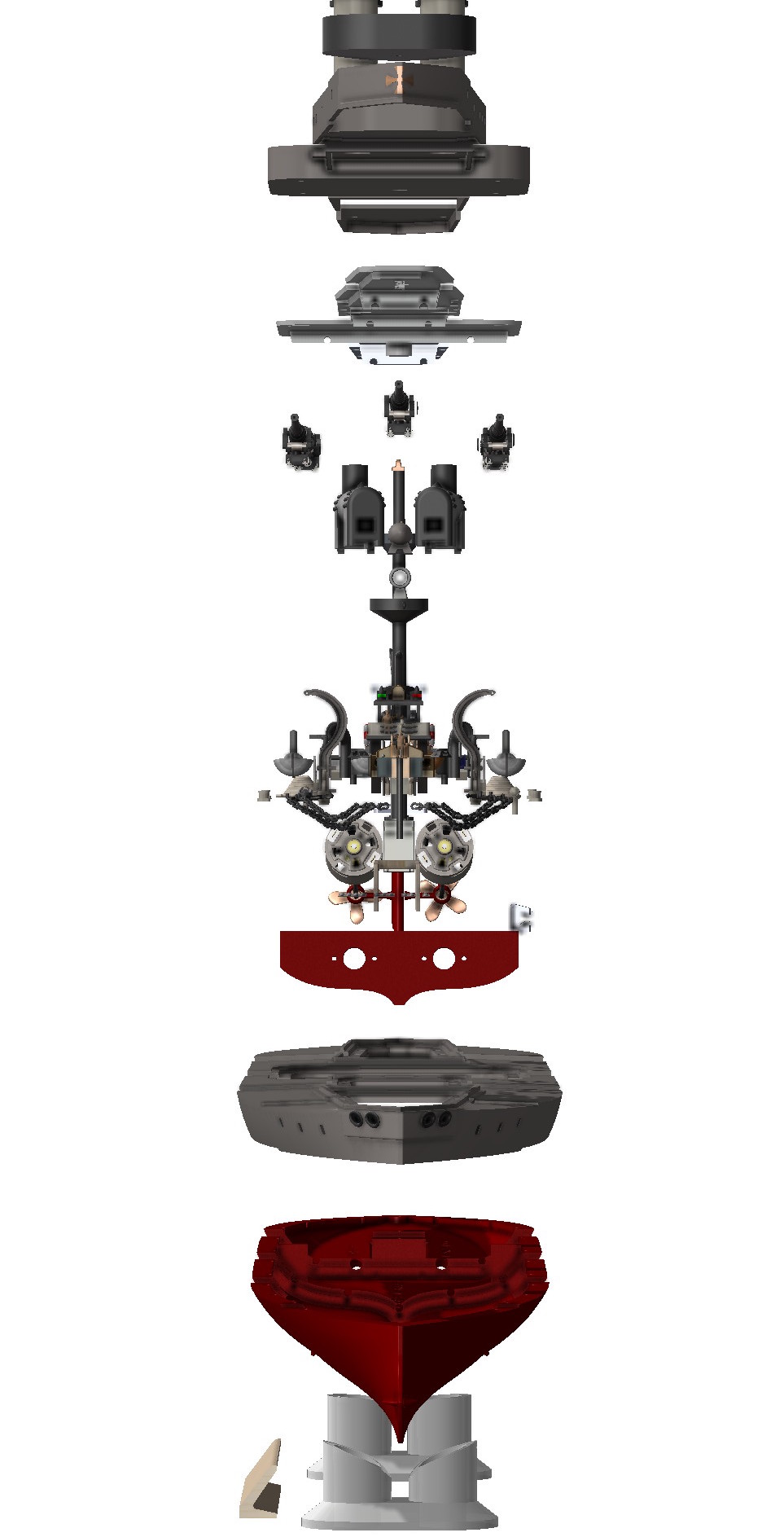
At 1:96 scale, the model offers a strong physical presence without becoming unmanageable in terms of printing or assembly. The structure is intentionally modular, allowing the hull and main body to be assembled in a clean and straightforward way. Alignment features and logical part division reduce guesswork, making the early stages of the build smooth and predictable.


A key design decision was to avoid forcing complexity. The core ship can be built relatively simply, providing a solid and accurate base model. From there, builders can choose to expand the level of detail by adding the included fittings, deck elements, and historically inspired components. This flexible approach allows the model to suit different preferences—whether as a clean display piece or a more involved, highly detailed project.

RC-Ready by Design
Beyond its visual qualities, the model has been developed as a functional platform for RC conversion. The hull is fully usable internally, with carefully considered volume for electronics, propulsion systems, and structural components. Interior access hatches are integrated into the design, making it practical to install, adjust, and maintain internal systems without difficulty.
Mounting areas and internal geometry are arranged to simplify the installation of motors, shafts, rudder systems, and wiring. The goal was not just to make RC conversion possible, but to make it logical and achievable without extensive modification. Builders with experience in RC modeling will find a solid foundation to work from, while others can still enjoy the model purely as a display piece.


A Project That Adapts to the Builder
What makes this model particularly rewarding is its flexibility. It does not demand that every detail be used or every feature be implemented. Instead, it allows the builder to decide the scope of the project:
- A straightforward build focusing on the hull and primary structure
- A detailed display model with full deck fittings
- Or a fully functional RC vessel with working systems
This adaptability mirrors, in a way, the historical ship itself—designed for a specific role, yet capable of evolving with changing needs.


The SMS Sachsen may not be the most widely recognized warship of its era, but it represents a crucial stage in naval development—a time when engineering, strategy, and national ambition were rapidly converging. Recreating such a vessel as a 3D printable model offers not only a building experience, but also a connection to that transitional period in maritime history.
With its balanced design, modular structure, and RC-ready potential, this model is intended to be both accessible and rewarding—whether you are looking for a clean, elegant display piece or a more ambitious working build.