The Unsung Guardian of Every Allied Port
Building the Little Boat That Held the Line, Now at 1:26 Scale and RC-Ready
There are warships that win battles, and then there are the vessels that make winning possible. The Harbour Defence Motor Launch belongs firmly in the second category — a small, purposeful, unglamorous wooden workhorse that kept Allied harbours, anchorages, and coastal waters safe throughout the Second World War without ever seeking glory or recognition. It was never the fastest boat in the fleet, never the most heavily armed, and never the one the newspapers wrote about. But remove it from the picture and the entire logistical backbone of Allied naval operations becomes significantly more vulnerable. The HDML was, in the truest sense, essential.
Continue reading for the full story, or head straight to our Cults3D listing to get the 1:26 scale RC-ready HDML model.
A Boat Born from Necessity
The HDML was designed by W. J. Holt at the British Admiralty in early 1939, in the months before war broke out, in response to a clear and growing need. As the prospect of a major European conflict became increasingly certain, the Admiralty recognized that its ports, anchorages, and harbour approaches would require dedicated anti-submarine patrol craft that could operate in shallow water, work continuously regardless of weather, and be built quickly and cheaply from materials and skills already available in the British boatbuilding industry. The answer was a 72-foot wooden-hulled motor launch with a shallow draught, twin diesel engines, and a weapons fit suited to coastal patrol and anti-submarine work.
The construction approach was deliberately practical. Rather than requiring naval shipyards already stretched by destroyer and submarine orders, the HDML was designed to be built by yacht builders — the small private boatyards dotted around the British coastline that possessed exactly the skills needed to plank and finish a wooden hull of this size. Most hulls were built in mahogany, though as the war progressed and timber supplies became strained, larch was increasingly used as a substitute, with the drawback that larch hulls proved somewhat more prone to leaking in service. The result of this production strategy was impressive: 486 HDMLs were completed during the war years, built not only in Britain but across the Commonwealth and the United States.
The Boat in Detail
At 72 feet overall with a beam of 16 feet and a draught of just 5 feet, the HDML displaced 54 tons at full load and was driven by twin Gardner 8L3 marine diesel engines producing 152 brake horsepower each, giving a top speed of 12.5 knots — adequate for the patrol and escort duties she was built for, if not spectacular. A complement of ten — two officers, two petty officers, and six ratings — worked and lived aboard in conditions that were functional rather than comfortable, as was standard for small warships of the era.
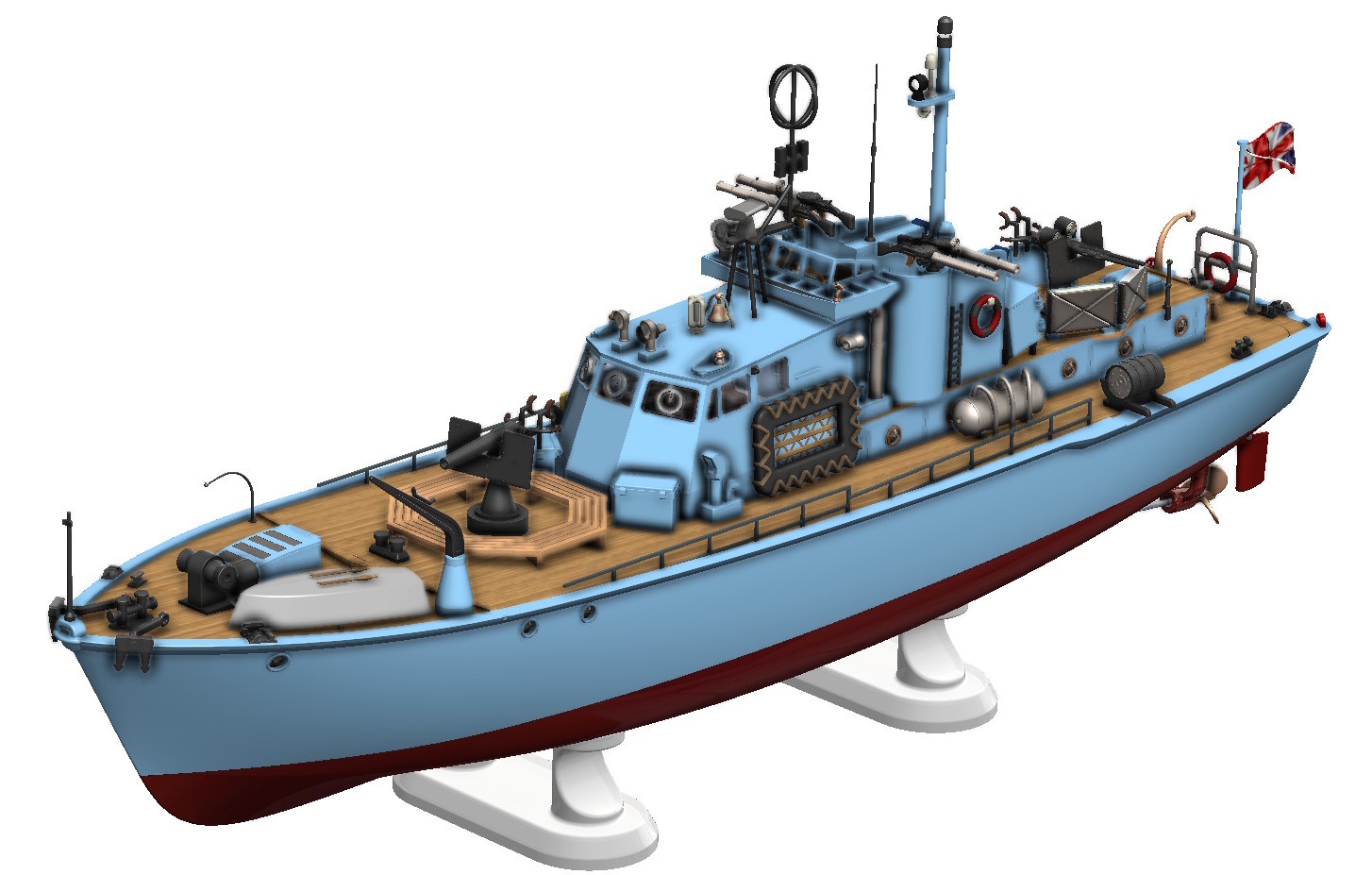
The armament evolved over the war but typically included a QF 2-pounder gun or 3-pounder on the foredeck, an Oerlikon 20mm cannon on the stern cabin roof that could be trained against surface targets or aircraft, and twin Vickers .303 machine guns mounted on each side of the bridge. Below the waterline she carried depth charges for anti-submarine work, and was also equipped with ASDIC — the British term for the active sonar system used to detect submerged submarines — which was the primary tool of her trade. She was, in short, a complete and capable anti-submarine patrol vessel in a very small package.
A Global Presence
The scale of HDML production and deployment across Allied navies gives a sense of how critical these little vessels were considered. The Royal Navy operated hundreds of them across every theatre of the war — the North Sea, the Mediterranean, the Atlantic approaches, and the Far East. The Royal Australian Navy used them extensively in the Pacific, where their shallow draught and ability to work in confined coastal waters made them invaluable in the island-hopping campaigns. The Royal New Zealand Navy commissioned 24 of them for anti-submarine duties around the New Zealand coast and in the Pacific, operating in the 124th and 125th Motor Launch Flotillas from Auckland and Wellington. The Free French Navy, the Royal Hellenic Navy, and numerous other Allied naval services also operated HDMLs under Lend-Lease arrangements, with the majority of American-built examples nominally owned by the US Navy and transferred to Allied partners.
Some HDML hulls saw action in the most consequential operations of the war. HMS Medusa (HDML 1387), built by R. A. Newman & Sons in Poole in 1943, participated in D-Day operations — one of many HDMLs that worked the Channel approaches, guided landing craft, maintained harbour control, and ensured that the vast machinery of the Normandy landings had the close support it needed in the congested waters near the beaches. Another, HMAS HDML 1321, later known as HMAS Rushcutter, was present at the Japanese surrender of Timor in 1945 before going on to serve as a training vessel for the Royal Australian Naval Reserve until 1970. Their post-war lives were often as varied as their wartime service, with many going on to serve under the flags of newly independent nations or transitioning to civilian life as fishing boats, charter craft, and private motor yachts.
In view of the expanded combat roles some HDMLs took on in Commonwealth service beyond the original harbour defence brief, a number were formally redesignated as Seaward Defence Motor Launches (SDMLs) or Seaward Defence Boats (SDBs) — a recognition that these little vessels were doing far more than patrolling harbour entrances. They were genuine multi-role coastal combatants, operating wherever they were sent.
The Endtas Model — 1:26 Scale, 85cm, RC-Ready
At Endtas we have long been drawn to the vessels that history tends to overlook in favour of the famous capital ships and fleet submarines — the working boats, the patrol craft, the unglamorous hardworking hulls that actually held the line. The HDML is exactly the kind of subject we find most satisfying to model: a vessel with a real operational story, an authentic character in every line and fitting, and a human scale that makes it genuinely intimate as a model.
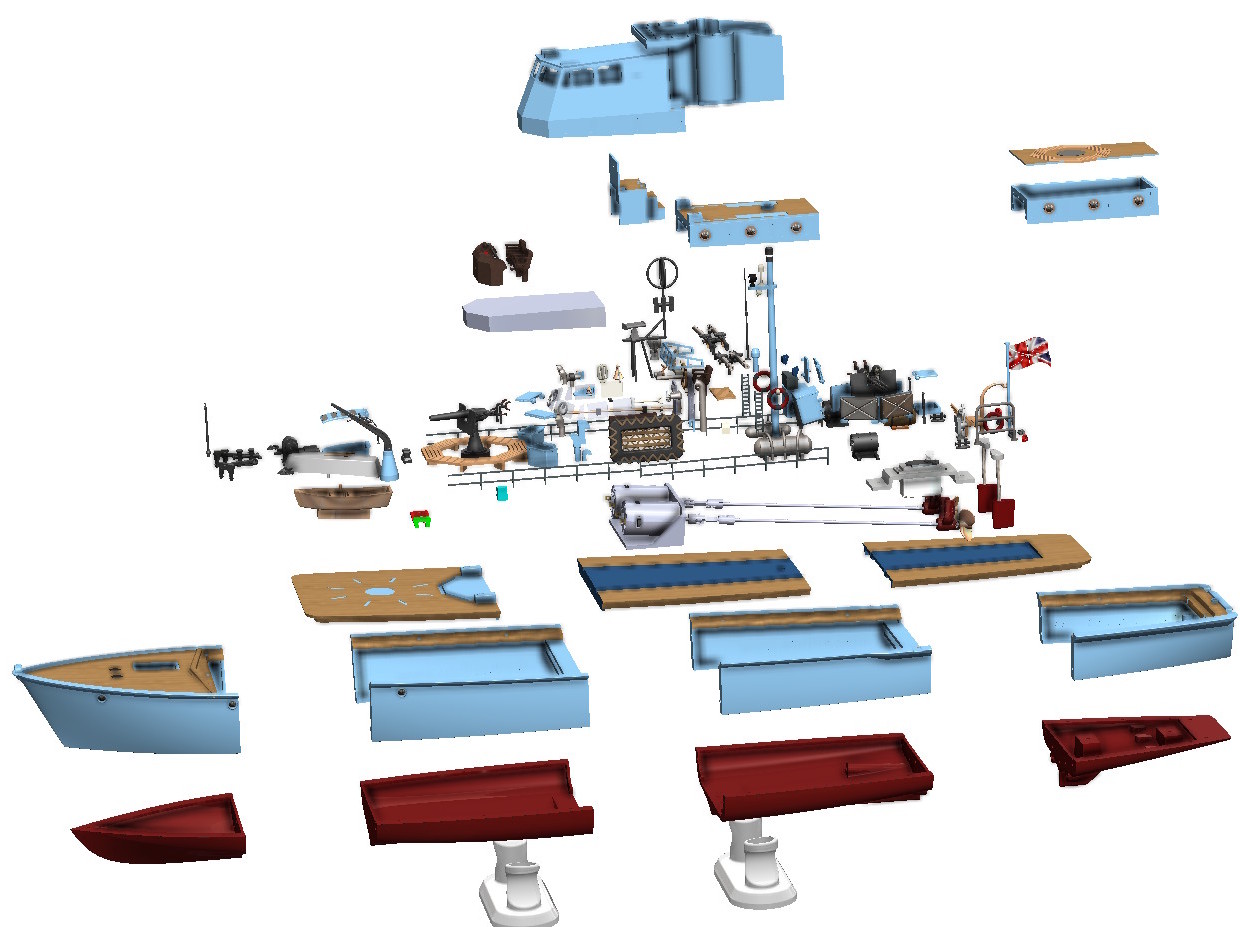
Our HDML model is built at 1:26 scale, producing a finished length of 85 centimetres — large enough to show off the full character of the original hull, all the deck detail, and the weapons and equipment that made these boats so capable, while remaining manageable on a standard workbench and printable on most desktop FDM machines. The model is fully RC-ready, with all the engineering needed for on-water operation built directly into the design from the start. The characteristic mahogany-plank hull form, the foredeck gun mount, the bridge and cabin structure, the depth charge racks, the Oerlikon position, and the twin exhausts are all faithfully represented, giving the finished model an authentic and purposeful presence that reflects the real vessel’s working character.
One of the most thoughtful engineering decisions in this model is the interior access system. Rather than scattering individual hatches across the deck, the entire deck — complete with the superstructure sitting above it — lifts away as a single assembly, exposing the full interior of the hull in one clean motion. This makes RC installation and maintenance genuinely straightforward: batteries, ESCs, receivers, and wiring are all immediately accessible without dismantling any part of the model. The removable assembly itself is made up of three separate printed parts that can be screwed and glued together into a solid, rigid unit. The complete assembly then sits in the hull secured by magnets or screws during RC operation — allowing quick removal on the waterside — or can be permanently glued shut for a seamless display finish with no visible fastening points.
Whether you are building a static display piece, a fully operational RC patrol boat, or simply want to own a scale model of one of the most historically significant small warships of the Second World War, the HDML is a deeply satisfying subject — compact, characterful, and rich with story. You can find the complete file pack and full model details on our Cults3D page. The link is below.
The HDML 3D printable model is available now on our Cults3D page.