Interpreting a Modern Naval Enigma Through 3D Modeling

The Qing-class submarine represents one of the most modern and least publicly documented submarine designs to emerge in recent decades. As a nuclear-powered ballistic missile submarine (SSBN) developed by China, it occupies a strategic role that is inherently opaque, with limited officially released plans, drawings, or dimensional data. This combination of technological significance and visual secrecy makes the Qing class both fascinating and challenging to interpret—particularly for modelers working without access to authoritative blueprints.


Our Qing-class 3D model is therefore not a literal reproduction, but a carefully researched and technically reasoned interpretation. Publicly available photographs, satellite imagery, comparative analysis with earlier Chinese submarine classes, and established submarine design principles were used to reconstruct the vessel’s overall proportions, hull geometry, and defining external features. Where reliable information ends, informed design judgment begins—always with the goal of maintaining visual plausibility, structural coherence, and a clean, manufacturable result.
Continue reading for more information and renderings,
or you can directly visit our purchase page on Cults3D.


Design Philosophy: Accuracy Where Possible, Clarity Where Necessary
Modern submarines are defined less by surface detail and more by subtle geometry: smooth pressure hull transitions, blended sail structures, and integrated control surfaces designed to minimize hydrodynamic noise. Translating this into a 3D printable format requires deliberate simplification without losing character. The Qing-class model captures the vessel’s imposing mass, elongated missile section, and distinctive sail profile while avoiding speculative micro-detail that would either be inaccurate or impractical to print.

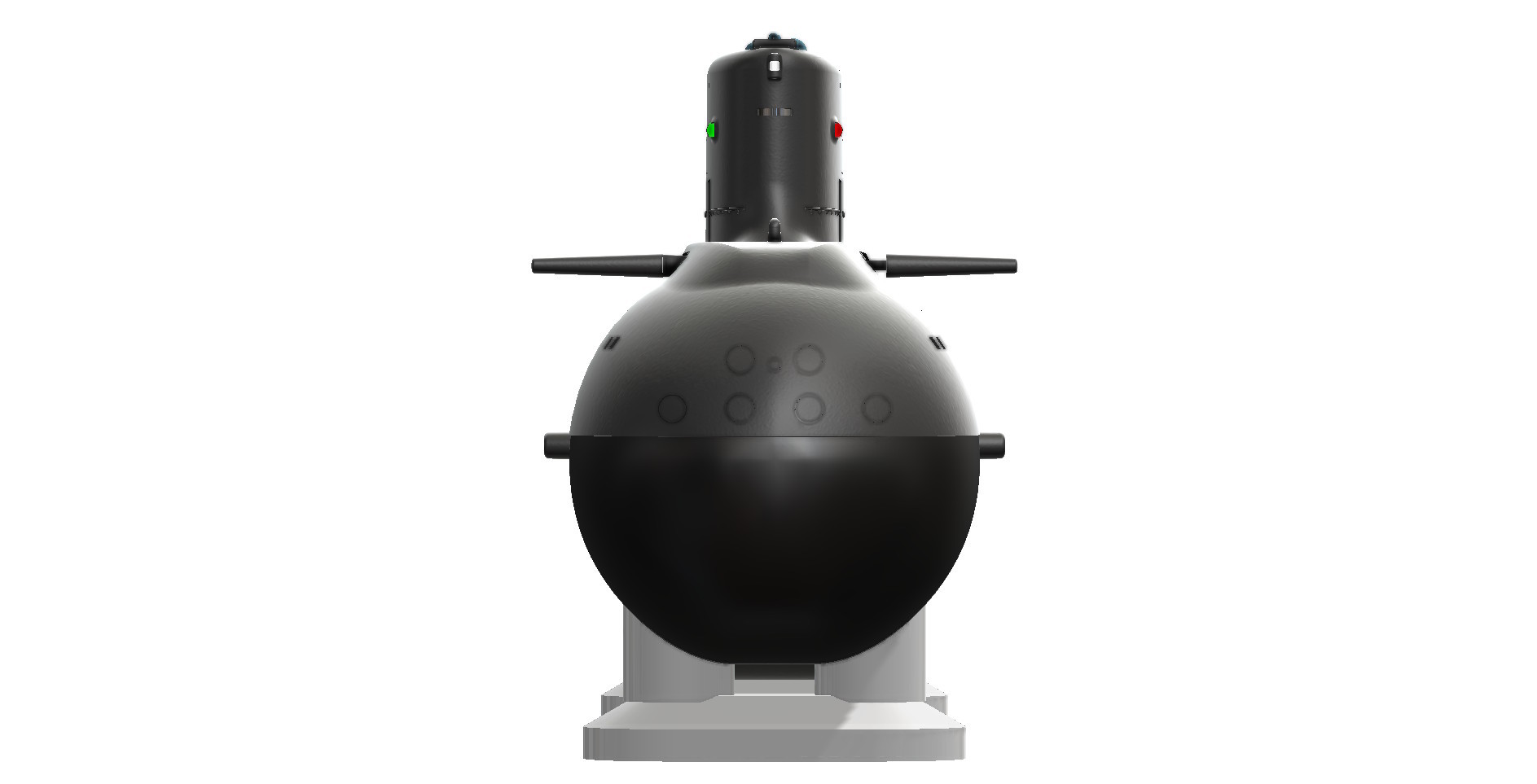
All major functional elements are articulated in the model, including dive planes, rudders, periscopes, missile silo hatches, and the escape pod. These features are not only visually engaging but also reinforce the mechanical logic of the submarine, allowing builders to understand how the real vessel operates while interacting with the model.

Internally, the hull is intentionally left empty. This decision serves two purposes: it keeps the model lighter and easier to print, and it provides a foundation for advanced builders who may wish to explore RC conversion, lighting, or internal structural experimentation. The top hull sections can function as large access hatches, enabling repeated interior access without compromising the exterior form.


Engineered for Builders, Not Just Display
The model is supplied as a comprehensive digital kit consisting of 42 optimized STL files and a full-color 3MF file for easier part identification and orientation. Internal alignment features and assembly bosses are integrated directly into the hull pieces, reducing guesswork during construction and improving structural accuracy during gluing and curing. The part breakdown is designed to fit standard desktop 3D printers while keeping support requirements to a minimum.


Although the Qing-class model is primarily intended as a high-impact display piece, it is not a static or fragile object. Wall thicknesses, joint interfaces, and articulation tolerances are all chosen with durability in mind. In the hands of an experienced builder—or an “RC wizard”—the model offers a realistic platform for experimentation far beyond simple shelf display.


A Contemporary Subject, Interpreted with Respect
Modeling a modern strategic submarine carries an inherent responsibility. This project avoids speculative internal systems, classified weapon layouts, or exaggerated claims of technical fidelity. Instead, it focuses on external form, mechanical logic, and build quality, offering enthusiasts a chance to engage with one of the most intriguing submarine designs of the modern era in a responsible and creative way.


The Qing-class submarine model is ultimately a study in balance: between realism and manufacturability, secrecy and interpretation, ambition and restraint. It is designed for builders who appreciate modern naval architecture, enjoy complex multi-part projects, and value models that reward careful assembly and thoughtful finishing.


As with all our large-scale submarine projects, this model is not about instant gratification—it is about the satisfaction of constructing something substantial, informed, and quietly imposing.
Please visit our purchase page on Cults3D to get this model.


 Users Today : 15
 Users Yesterday : 154
 Users Last 7 days : 1306
 Views Today : 21
 Views Yesterday : 250
 Views Last 7 days : 2044
 Total views : 1344233
 Who's Online : 0